
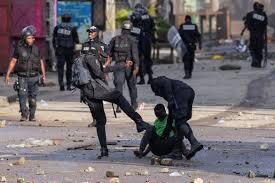
The Cameroon Human Rights Commission (CHRC) has unleashed a scathing indictment of what it calls a “premeditated assault” on democracy, which it said is fuelled by opposition firebrands and shadowy agitators. While stating that 14 lives have been lost, scores critically wounded, and public buildings reduced to rubble, the CHRC warns that the nation’s fragile peace hangs by a thread due to what it says are calls for outright insurrection masquerading as “peaceful demonstrations.”
The commission, tasked with safeguarding rights says it has been “closely monitoring the post-electoral situation in the country since the official proclamation of the results of the presidential election of 12 October 2025 by the Constitutional Council.” But what began as a tense wait for official tallies exploded into violence after opposition figures jumped the gun. “The Commission notes that the post-electoral period has been marked by the premature self-proclamation by the victorious mixed commission candidate, without waiting for the proclamation of the official tally by the Constitutional Council, which took place on 27 October 2025,” the CHRC states in its explosive press release dated November 3.
This rush to claim victory, the body charges, unleashed a torrent of chaos: “He has pursued a logic of unconstitutional change of government through repeated calls for insurrection and the massive use of disinformation, going so far as to print the logo of an insurrectional radio station.” What followed wasn’t dissent—it was destruction. The CHRC observes, with “consternation and profound sadness,” acts of violence that “have occurred following calls for ‘peaceful demonstrations’, which have in reality proven to be calls for insurrection.”
These incendiary pleas, “launched by the defeated candidate and relayed by certain political figures,” were amplified across social networks, urging “revolution, murders by non-state actors, agitators and subversive groups; property, including calls to seize police [stations], airports, and the destruction of public and private property.” The toll? Devastating. “The Commission records fourteen (14) deaths and one hundred and five (105) injured among the assailants and forty-four (44) among the defense and security forces, out of which eighty-one (81) are in critical condition.
“The violence also led to the destruction or serious damage to public and private infrastructures, including town halls, schools, sub-prefectures, courts, ELECAM local offices, customs posts, filling stations, municipal buildings, companies and shops, residences of local authorities, streetlights, surveillance cameras, as well as public and private construction vehicles, among them a fire-engine and several vehicles belonging to a road company.”
The CHRC says it extends “its deepest condolences to the bereaved families and wishes a speedy recovery to all those injured, whether members of the defense and security forces or civilians.”
It expresses solidarity with all those whose property, businesses or official documents have been destroyed or damaged. These aren’t mere riots, the commission insists—they’re “serious violations of fundamental rights, notably the right to life, the right to physical and moral integrity, the right to security, the right to property.”
Arrests have surged past 1,200 nationwide, with hotspots in the Adamawa (146), East (257), Far North (100), Littoral (29), North (59), and West (272) Regions.
Video evidence, the CHRC says, lays bare the brutality: “The Commission examined video evidence illustrating the gravity of the violence,” including footage of “a young gendarme, wounded and exhausted, vainly attempting to escape lynching by enraged assailants,” and “in Douala II, Jean Pierre Tony, a journalist stabbed and beaten, brutally assaulted on 27 October 2025 on the right side after one shot: ‘Kill them! They are CRTV journalists!'” In a gut-wrenching detail, worshippers at a Douala mosque “prayed for him by seeking refuge there, they are demonstrating inside a mosque, where Muslim worshippers granted him protection, thereby demonstrating the solidarity and humanity
The Commission recalls that the right to peaceful assembly is guaranteed by the Constitution of Cameroon and by Law No. 90-055 of 19 December 1990, as well as by the African Charter on Human and Peoples’ Rights, Article 11 on Assembly and Demonstration.” But “the acts observed in several cities cannot be characterised as peaceful demonstrations,” the body retorts— they were “looting and destruction, those involved were rioters and insurgents, armed and responsible for arson, commercial destruction areas, filling and banking establishments, schools, residences.”
In a broader swipe at the ‘architects of unrest’, the CHRC decries “international and transnational actors who, without considering the gravity of the violence observed, have called the acts ‘respect the freedom of peaceful assembly’ in a context where the very nature of the acts committed such a qualification.” It “strongly recalls that the freedom of peaceful assembly can in no case serve as a pretext for sedition, violation, destruction of public or private property, or attack on human life.”
The commission quotes Article 23 of the African Charter: “The unconstitutional change of government consists of a flagrant violation of Article 23 of the African Charter that ‘any putsch, coup d’état against or attempt to overthrow a democratically elected government is strictly prohibited and shall draw appropriate sanctions.'” This, it argues, “comprises constitutional order and undermining the legitimacy of democratic institutions,” liable to “disrupt the normal functioning of post-election institutions and the expectations of citizens’ rights.”
As Cameroon shakes, the CHRC urges restraint and renewal: “The Commission reiterates that any violent contestation lies outside the democratic framework.” It commends “the efforts of the administrative authorities who were in the field to engage with local populations, as well as those of the defense and security forces who adopted a measured and pedagogical approach to maintaining public order.” To the forces on the frontlines: “It encourages the defense and security forces to pursue this approach, ensuring at all times strict compliance with national and international standards on law enforcement operations.”