
By Nfor Hanson Nchanji-
BSc. Journalism and Mass Communication
MBA International Relations and Diplomacy
I. Executive Summary: The Centralized Security Architecture of Cameroon
This analysis does not come from a security expert but an observer, a journalist and international relations enthusiat. The piece addresses the structure and leadership of Cameroon’s key security forces, the National Police (DGSN), the National Gendarmerie (SED), the Rapid Intervention Brigade (BIR), and the conventional Armed Forces (CEMA), to clarify the command positions amid ongoing political and social unrest. The security sector in Cameroon is characterized not by a streamlined, unified hierarchy, but by a personalized, hyper-centralized structure deliberately crafted to ensure regime longevity. This system operates through fragmented and often competing chains of command, a design that critically undermines institutional accountability, particularly when these forces are deployed during civil unrest.
1.1. Overview of Command Fragmentation
The bedrock of Cameroon’s security doctrine rests on the direct and absolute authority of the
Presidency. While standard governance relies on the Ministry of Defence (MINDEF) and the
Chief of Staff of the Armed Forces (CEMA) for military policy and external defense, the most critical instruments of internal coercion, the General Delegation for National Security (DGSN) and the elite Rapid Intervention Brigade (BIR), are structurally isolated and report directly to the Presidency. This arrangement ensures that the Head of State retains immediate, non-negotiable operational control over the forces most likely to suppress political dissent.
1.2. Summary of Current Command Verification
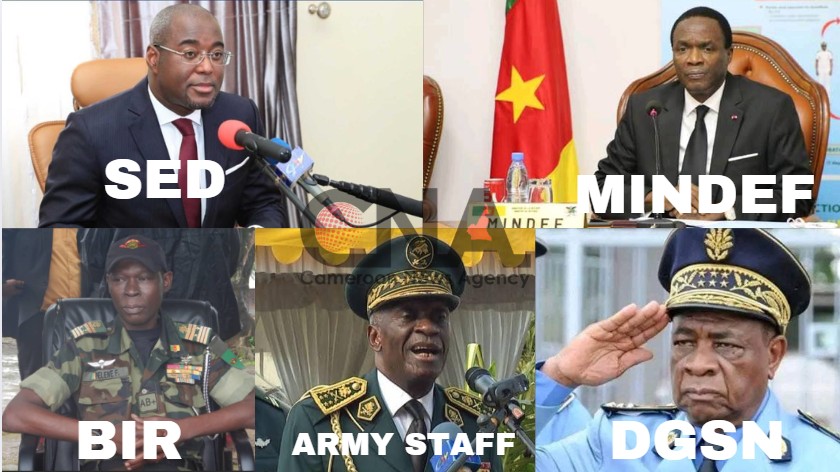
To address public concern and media queries regarding the roles of specific commanders, verification confirms that the following key leadership positions are currently held by long-serving and politically pivotal figures:
- The Minister Delegate at the Presidency in charge of Defence (MINDEF) is BETI ASSOMO Joseph .
- The Delegate General for National Security (DGSN) is MBARGA NGUELE Martin .
- The Secretary of State to the Minister of Defence in charge of the National Gendarmerie (SED/CGN) is ETOGA Galax Yves Landry. 7
- The Chief of Staff of the Armed Forces (CEMA) is General René Claude Meka . 8
- The General Coordinator of the Rapid Intervention Brigade (BIR) is Brigadier General Pelene Francois . 9
This verification confirms that General Meka, having served since September 2001, remains in command, addressing the query regarding the status of long-tenured generals.
1.3. The Protest Context
Cameroon has experienced heightened social upheaval, economic inequality, and separatist violence, particularly in the years following the 2016 Anglophone crisis and subsequent presidential elections. Post-election violence in 2025/2018 resulted in civilian fatalities and mass arrests as security forces moved to break up demonstrations. The deployment of security forces during these critical periods, often involving the Police, Regular Amry , Gendarmerie, and the specialized BIR, raises serious questions regarding chains of command, accountability, and the authorization of lethal force. Clarifying the roles and reporting lines of the commanders responsible for these operations is paramount to understanding where responsibility lies when excesses occur.
II. The Highest Echelon: Political, Strategic, and Military Oversight
The strategic command of Cameroon’s security forces flows from the constitutional and personalized power vested in the Head of State, filtering down through two primary, semi-autonomous hierarchies: the Ministry of Defence (MINDEF) for policy and the Presidency itself for direct operational control, several sources have stated.
2.1. The Commander-in-Chief and Presidential Supremacy
The President of the Republic, His Excellency Paul Biya, serves as the Supreme Commander of all defense and security forces. This position grants him definitive authority over all security matters, allowing him to bypass traditional military and ministerial channels when deploying forces, a power central to his long tenure and ability to govern by maintaining tight control over the coercive apparatus. The foundational “Greater Ambitions” platform, upon which the President was elected, explicitly links national progress to the maintenance of peace and security, thereby placing security forces at the center of the political project.
2.2. The Minister Delegate at the Presidency in Charge of Defence (MINDEF)
The role of MINDEF is strategic and administrative rather than purely operational. The Minister Delegate at the Presidency in charge of Defence is responsible for the overall elaboration and implementation of national defense policy. 5 His duties include coordinating and controlling forces of law and order, organizing military tribunals, and managing military cooperation. 5
The current holder of this influential position is BETI ASSOMO Joseph . 5 While MINDEF controls the strategic direction and resource allocation for the majority of the conventional military and the Gendarmerie (via the SED), its direct functional authority over the forces most frequently deployed for politically sensitive internal crackdowns, specifically the DGSN and the BIR, is structurally limited by the President’s separate command lines. 1 This structural limitation ensures that MINDEF is primarily an institution of defense policy and conventional military governance, rather than the undisputed locus of internal security power.
2.3. The Chief of Staff of the Armed Forces (CEMA)
The Chief of Staff of the Armed Forces (CEMA) oversees the command and operational readiness of the regular military components, including the Army, Navy, and Air Force. Conventionally, the army’s primary responsibility is external security, though it carries shared domestic security duties. 4
The current CEMA is General René Claude Meka .8 General Meka has held this critical post since September 2001, a tenure of over two decades.8 The verification of his active status is vital, as the original inquiry noted that other high-ranking officials, such as General Rene Ze Meka, are retired. General Meka’s continued command underscores the political determination to maintain personnel consistency in sensitive security roles, a feature characteristic of personalized authoritarian systems. 8
The longevity of General Meka, mirroring President Biya’s own long rule, demonstrates a profound institutional stability—or, viewed critically, stagnation—within the command structure. This long service prioritizes personal loyalty and political reliability over institutional dynamism or the regular modernization of the conventional military hierarchy. The consequence of this arrangement is that the conventional military chain of command, led by the CEMA, is structurally marginalized regarding internal security operations, which represent the primary threat to the regime. Because internal security operations are managed by forces that bypass the CEMA’s authority (DGSN, BIR) 1 , the CEMA’s authority is primarily confined to external defense and the conventional military hierarchy, effectively diminishing his internal political influence and safeguarding presidential supremacy over domestic enforcement.
III. Forces of Internal Security: DGSN and National Gendarmerie
Cameroon relies on two major uniformed services for internal law enforcement: the National Police, managed by the DGSN, and the National Gendarmerie, managed by the SED. Though both carry police mandates, they are separated by jurisdiction and, critically, by command structure.
3.1. The General Delegation for National Security (DGSN) – National Police
The DGSN has the primary legal mandate for law enforcement, judicial policing, and territorial security, concentrating its operations primarily in urban areas. 16 The fundamental task of maintaining peace and security is explicitly assigned to the DGSN. 2
The Delegate General for National Security is MBARGA NGUELE Martin . 6 The Police force under his command is placed under the direct authority of the Presidency . 2 This direct reporting line is indispensable for ensuring the police, which faces urban dissent and manages the national identification process (a key tool of civilian control) 18 , remains immediately responsive to the Head of State. This structural arrangement ensures that the policing of the politically sensitive urban landscape is always aligned with presidential directives, bypassing the bureaucratic layers of MINDEF.
3.2. The Secretariat of State for Defence (SED) – National Gendarmerie
The National Gendarmerie, dating back over a century, is categorized as a military force with concurrent civilian and military police duties. 19 It is distinct in its primary responsibility for law enforcement in rural areas . 16 Its operational functions include administrative, criminal, and military police investigations, and it is actively involved in law enforcement through its extensive network of Mobile Squadron Groups and platoons. 19
The Gendarmerie reports to the Secretariat of State for Defence (SED) in charge of the National Gendarmerie, a dedicated branch of the Ministry of Defence. 3 The current Secretary of State to the Minister of Defence in charge of the National Gendarmerie (SED/CGN) is ETOGA Galax Yves Landry . 7 He presides over the installation of senior Gendarmerie commanders, overseeing regional commands and ensuring institutional effectiveness. 3
The coexistence of the DGSN (under the Presidency) and the Gendarmerie (under
MINDEF/SED) creates a system where overlapping mandates for law enforcement exist, albeit with distinct jurisdictional concentrations (urban vs. rural). 16 This overlap results in institutional competition and complicates coordination during national crises, but it serves a strategic political purpose: it prevents any single security service from establishing monolithic control over internal security operations, thereby mitigating the risk of a rival power center emerging against the Presidency.
Furthermore, the militarization of civilian policing is a critical consequence of this duality. The Gendarmerie, functioning under military statutes , facilitates the rapid escalation of force during public order management. When deployed alongside civilian police (DGSN) in protest situations, the military nature of the Gendarmerie means its response is governed by regulations that are often more permissive regarding the use of lethal force than standard police guidelines. The legal framework, which allows law enforcement to use firearms when necessary to defend a post or protect entrusted installations , has been criticized as being “more permissive than international law allows,” thus providing a legal justification for lethal responses during periods of unrest.
IV. The Presidential Elite Unit: The Rapid Intervention Brigade (BIR)
The Rapid Intervention Brigade (BIR) occupies a unique and powerful position within Cameroon’s security infrastructure. It is not merely another military unit but the regime’s
specialized, autonomous, and primary coercive instrument, deployed where counter-insurgency and maximum force are indispensable.
4.1. Institutional Isolation and Operational Autonomy
The BIR operates entirely outside the conventional military chain of command. It possesses an independent chain of command that bypasses both the General Staff (CEMA) and the Ministry of Defence (MINDEF). The BIR reports directly to the office of the President . 1
Its financial independence further cements its autonomy. The unit draws its entire budget from the Société nationale de hydrocarbures (SNH), the state oil rents. 1 This exclusive funding mechanism provides the President with immediate, unconstrained access to operational capital, ensuring the unit’s loyalty remains tied exclusively to the Presidency and insulated from standard military budgeting oversight. This resource superiority contributes to the BIR being better equipped, trained, and paid than regular army units. 23
4.2. Leadership and Coordination
The General Coordinator/Commander of the Rapid Intervention Battalion is currently
Brigadier General Pelene Francois . General Pelene’s promotion to Brigadier General and his recognized history in combating transnational threats, including highway banditry, poaching, and the Boko Haram insurgency , highlight the high operational status of the BIR. His elevation in rank, confirmed by documents referring to him previously as Colonel, reinforces his command authority over this elite force.
The BIR’s mandate focuses on high-level counter-insurgency and anti-terrorism operations. However, it has been systematically redeployed to suppress political dissent and violent separatism in the Anglophone regions.
4.3. The BIR as a Coup-Proofing Mechanism
The distinctive combination of direct presidential reporting, independent, oil-based funding, and specialized, isolated operations makes the BIR the ultimate structural safeguard for the regime. It functions as a politically loyal force designed to operate outside institutional checks and balances.
This preferential status and institutional isolation ensure that, regardless of any potential internal dissent or challenge originating from the regular military establishment (under CEMA/MINDEF), the President maintains an immediate, effective, and politically reliable armed response. This structural fragmentation is a deliberate political calculation designed to prevent the conventional military from unifying power and potentially challenging the regime.
V. Operational Deployment: Command Responsibility in Context of Protests
The complexity of command structures converges critically during periods of mass protest and internal unrest, necessitating the simultaneous deployment of forces with distinct legal mandates and reporting lines.
5.1. The Legal Framework for Use of Force
Cameroonian legislation stipulates that security measures “shall not be used beyond what is strictly necessary”. However, the laws governing the application of force provide substantial latitude to law enforcement. Specifically, the 2003 Law on Internal Security permits law enforcement officials to use firearms when necessary to defend occupied posts or protect installations and personnel entrusted to them. This framework is considered notably permissive in comparison to international standards governing proportional use of force.
A crucial legal distinction is that civilian authorities may only have recourse to the armed forces (the Army, and often the military Gendarmerie units) for public order management based on a specific requisition order. 21 This requisition mechanism is the formal administrative act that legitimizes the shift from civilian policing to military suppression of internal dissent.
5.2. Civilian Authorities and Security Mobilization
In practice, administrative officials play a vital political role in triggering security deployment. The Minister of Territorial Administration (MINAT, currently ATANGA NJI Paul 15 ) holds the administrative power to issue bans on public gatherings, while Regional Governors (such as Samuel Dieudonne Ivaha Diboua of the Littoral Region) authorize and oversee the response to unrest within their administrative areas. This was seen recently when Minister Atanga NJi ordered his governors not to allow any gatehrign that could affect public peace.
The response often begins with political allegations—for instance, regional governors describing demonstrators as “attacking” Gendarmerie brigades or police stations. 12 This characterization is used to satisfy the legal requirement for deploying highly armed forces and invoking the permissive use-of-force clauses, effectively legitimizing the use of military units for crowd control and transforming political demonstrations into security operations.
5.3. Tactical Coordination and Lack of Control
During major incidents, such as the post-election violence documented in Douala, Garoua, Bertoua, Maroua, and other urban areas, multiple security elements—Police (DGSN),
Gendarmerie (SED), and, implicitly, the BIR—are often involved. 4 This convergence of units, operating under three different functional chains of command (DGSN to Presidency, Gendarmerie to MINDEF/SED, BIR directly to Presidency), inevitably leads to coordination issues and a lack of clear operational control. 3
The structural separation of the forces—particularly the BIR’s isolation from the regular General Staff —ensures that the actions taken by these elite units are often outside the standard operational command framework used by regional Gendarmerie or Police commanders. The consequence of the requisition requirement, which transfers responsibility from civilian police to military units, is the formal legalization of the militarization of public order management. This process directly increases the likelihood of lethal outcomes, as witnessed during clashes where security forces were alleged to have caused civilian fatalities.
The complexity of these operational layers means that when abuses occur, accountability is severely diluted. If an officer from the highly autonomous BIR commits an unlawful killing, the investigation process must navigate conflicting jurisdictional claims among the DGSN (who may make the initial arrest) , MINDEF (responsible for military discipline), and the direct Presidential chain of the BIR. This systemic lack of effective control facilitates a policy of impunity for serious violations of international human rights law.
VI. Accountability and Governance Challenges
The security architecture, designed for political control through fragmentation, inherently generates profound governance and accountability challenges that manifest as systemic human rights violations.
6.1. Systemic Impunity and Abuses by State Forces
Human rights organizations consistently report credible allegations that government security forces are responsible for unlawful or arbitrary killings, torture, enforced disappearances, and the destruction of civilian property, particularly in crisis regions. While the government occasionally reports taking steps to identify and punish officials who commit abuses 25 these efforts are insufficient to overcome the structural barrier of impunity. The decision to pursue prosecution is often utilized as a selective political tool—a measure to manage international pressure or internal political demands—rather than a consistent function of professional, institutional oversight.
6.2. The Challenge of Civilian and Military Control
Official reports underscore that civilian and military authorities “at times did not maintain effective control over the security forces. This deficit of control is an unavoidable consequence of the strategy of coup-proofing, which prioritizes loyalty above institutional coherence. By deliberately isolating powerful units, such as the BIR, from the regular military chain of command 1 , the state fosters an environment where units feel answerable only to the highest authority, insulating them from lower-level command oversight and civilian administrative mandates.
6.3. Politicization of Security and Justice
The security apparatus is highly politicized, extending its reach into the judicial and informational spheres. Individuals critical of the authorities, including journalists and political activists, face intimidation, arbitrary detention, and prosecution, often under broadly applied laws related to terrorism or national security. 30 The arrest of activists and their subsequent trial in military courts further illustrates the militarization of the political space .
The structural fragmentation of the security forces creates an information asymmetry that complicates international efforts to promote security sector reform. International partners continue military cooperation and supply equipment. 13 However, since the BIR and DGSN bypass MINDEF, donors who primarily interface with the MINDEF hierarchy often lack transparency regarding how the most coercive units are deployed and controlled by the Presidency. This structural opacity allows the regime to maintain its personalized command structure while deflecting international accountability efforts.
VII. Key Organizational Tables
To provide clarity and a concrete reference for the public, the current organizational landscape of Cameroon’s security leadership and operational deployment is summarized below.
Table 1: Key Security Command Posts and Current Leaders (Verification)

Table 2: Operational Mandates and Deployment in Internal Security

VIII. Conclusion and Policy Implications
7.1. Recommendations for Public Sensitization and Policy Action
The clarification of the command structure leads to several necessary recommendations for promoting transparency and accountability, particularly during public order operations:
- Mandatory Public Disclosure of Requisition Orders: To ensure transparency, all formal requisitions for military units (Gendarmerie, Army, or BIR) to engage in public order management must be publicly disclosed by the requesting civilian authority, thereby assigning immediate responsibility for the deployment. 21
- Standardization of Rules of Engagement (ROE): The government must standardize and publicly commit to international human rights standards regarding the use of force, ensuring a unified, non-lethal approach to crowd control across all deployed units (DGSN, Gendarmerie, and BIR). The current legal flexibility regarding the use of firearms must be immediately tightened to conform to the principles of necessity and proportionality.
- Strengthening MINDEF’s Functional Control: Efforts toward genuine security sector reform must involve functionally strengthening MINDEF’s control over all defense forces. Reducing the ability of specialized units to operate entirely outside the standard chain of command is essential for mitigating risks of abuses and reducing presidential centralization.
- Enhancing Judicial Oversight: Ensuring that cases involving alleged excesses by security forces, are handled by independent civilian judicial bodies rather than military tribunals is critical to addressing the persistent “policy or practice of impunity.”. 26
7.2. Conclusion:
This analysis, compiled in anticipation of the proclamation of the results of the October 2025 presidential elections, underscores a critical and persistent vulnerability in Cameroon’s security architecture. The violent public clashes and subsequent security force action documented immediately following the official results declaration on October 27, 2025, tragically validated the core premise of this article: that the personalized and fragmented chain of command ensures a rapid, often excessive, coercive response to political challenges.
The enduring stability of top commanders, the Delegate General MBARGA NGUELE Martin
(DGSN), Secretary of State ETOGA Galax Yves Landry (Gendarmerie), General
Coordinator/Commander; Pelene Francois (BIR), and Chief of Staff General René Claude Meka (CEMA), reflects a system that prioritizes loyalty and centralized control over institutional accountability. Crucially, the forces most implicated in the post-election crackdown, the Police, Gendarmes, Regular Army, and BIR- operate with independent reporting lines directly to the Presidency, bypassing the conventional military and ministerial oversight.
Reasons why in places like Bertoua, the Police lamented that they suspect the military was helping the protesters by shielding them. But this brings up to question of who protects the civilians better: Police or Army?
Amidst civil unrest, this deliberate fragmentation inevitably creates an accountability gap. When uniformed personnel are deployed under overlapping mandates, the legal framework, which allows security forces wide latitude for the use of firearms in defense of installations, becomes a mechanism for justifying lethal responses to political dissent. The immediate aftermath of the 2025 election, characterized by reported civilian fatalities and mass arrests, highlights that the ultimate responsibility for the militarization of public order management rests not with the individual soldier but with the political leadership utilizing these hyper-centralized chains of command. Moving forward, genuine stability requires that Cameroonians demand transparency over the command structure and the use of the requisition power, ensuring that those in command of the nation’s powerful security forces are held to account for the actions taken in the name of order.
References
- Security force assistance to Cameroon: how building enclave units deepens autocracy | International Affairs | Oxford Academic, accessed on October 24,
2025, https://academic.oup.com/ia/article/98/6/2099/6783019
- The General Delegation for Presidential Security (DGSN) – PRC.CM, accessed on October 25, 2025,
-general-delegation-for-presidential-security-dgsn
- cameroon actors of protection – Department of Justice, accessed on October 24,
2025, https://www.justice.gov/eoir/page/file/1349551/dl
- 2021 Country Reports on Human Rights Practices: Cameroon, accessed on October 24, 2025,
https://cm.usembassy.gov/2021-country-reports-on-human-rights-practices-ca meroon/
- BETI ASSOMO Joseph | Prime Minister’s Office – Services du Premier Ministre, accessed on October 24, 2025,
- MBARGA NGUELE Martin | Prime Minister’s Office – Services du Premier Ministre, accessed on October 28, 2025,
- ETOGA Galax Yves Landry | Prime Minister’s Office – Services du Premier Ministre, accessed on October 19, 2025,
- accessed on October 19, 2025, https://www.trtafrika.com/english/article/664d777ae61e#:~:text=The%20Chief%2 0of%20Staff%20of,military%20chief%20since%20September%202001.
- Brigadier General PELENE François communion with colleagues, family members, friends and sympathizers on August 16, 2025 to celebrate his promotion to the rank of Brigadier General. – portail MINDEF, accessed on October 30, 2025, https://mindef.gov.cm/en/blog/brigadier-general-pelene-francois-communion-wi th-colleagues/
- EU urges ‘restraint’ after violent repression of protests in Cameroon – Arab News, accessed on October 23, 2025, https://www.arabnews.com/node/2620565/world
- Cameroon: Biya Declared the Winner Amid Post-Election Violence | Human Rights Watch, accessed on October 27, 2025,
https://www.hrw.org/news/2025/10/28/cameroon-biya-declared-the-winner-ami d-post-election-violence
- Clashes with security forces in Cameroon kill 4 protesters ahead of election results – WFTV, accessed on October 26, 2025,
- Human Rights Violations in Cameroon’s Anglophone North-West Region, accessed on October 20, 2025,
https://www.amnesty.org/en/latest/research/2023/06/human-rights-violations-in- cameroons-anglophone-north-west-region/
- “These Killings Can Be Stopped”: Abuses by Government and Separatist Groups in Cameroon’s Anglophone Regions – Human Rights Watch, accessed on October
21, 2025,
https://www.hrw.org/report/2018/07/19/these-killings-can-be-stopped/abuses-go vernment-and-separatist-groups-cameroons
- The Prime Minister and his Collaborators – Services du Premier Ministre, accessed on October 29, 2025,
https://www.spm.gov.cm/site/?q=en/content/prime-minister-and-his-collaborator s
- 2016 Country Reports on Human Rights Practices: Cameroon – state.gov, accessed on October 30, 2025,
https://2017-2021.state.gov/reports/2016-country-reports-on-human-rights-prac tices/cameroon/
- Paul Biya: World’s oldest president in a country ruled by veterans – TRT Afrika, accessed on October 30, 2025,
- Martin Mbarga Nguele: The New National ID System will Launch this Month, accessed on October 28, 2025,
– new-national-id-system-will-launch-this-month
- presentation – Gendarmerie Nationale, accessed on October 19, 2025, https://mindef.gov.cm/gendarmerie-nationale/en/presentation/
- RECENTLY APPOINTED GENERALS IN THE CENTRAL ADMINISTRATION OF THE NATIONAL GENDARMERIE INSTALLED, accessed on October 26, 2025, https://mindef.gov.cm/gendarmerie-nationale/en/2025/09/02/recently-appointed- generals/
- International – African Commission, accessed on October 26, 2025, https://achpr.au.int/sites/default/files/files/2023-02/eng-achpr-use-force-study-e dited.docx
- Study on the Use of Force by Law Enforcement Officers and Prison Guards – International Service for Human Rights, accessed on October 27, 2025, https://ishr.ch/wp-content/uploads/2023/11/EN-Study-on-the-Use-of-Force-by-L aw-Enforcement.docx
- Rapid Intervention Battalion – Wikipedia, accessed on October 27, 2025, https://en.wikipedia.org/wiki/Rapid_Intervention_Battalion
- North West: BIR inaugurates new base in Kumbo to better combat separatist fighters, accessed on October 27, 2025,
https://theguardianpostcameroon.com/post/2797/fr/north-west-bir-inaugurates- new-base-in-kumbo-better-combat-separatist-fighters
- 2024 Country Reports on Human Rights Practices: Cameroon, accessed on October 25, 2025,
https://cm.usembassy.gov/2024-country-reports-on-human-rights-practices-ca meroon/
- Cameroon – Global Centre for the Responsibility to Protect, accessed on October 30, 2025, https://www.globalr2p.org/countries/cameroon/
- Crisis in the Republic of the Cameroon – Congress.gov, accessed on October 25, 2025,
https://www.congress.gov/115/meeting/house/108492/witnesses/HHRG-115-FA1 6 -Wstate-TembonE-20180627.pdf
- Cameroon protests turn deadly ahead of presidential election results – Yahoo News Canada, accessed on October 20, 2025,
https://ca.news.yahoo.com/four-killed-cameroon-security-forces-010258691.ht m l
- 2022 Country Reports on Human Rights Practices: Cameroon – U.S. Department of State, accessed on October 20, 2025,
https://www.state.gov/reports/2022-country-reports-on-human-rights-practices/ cameroon /
- Human rights in Cameroon – Amnesty International, accessed on October 25, 2025,
https://www.amnesty.org/en/location/africa/west-and-central-africa/cameroon/re port-cameroon /
- 2023 Country Reports on Human Rights Practices: Cameroon – U.S. Department of State, accessed on October 20, 2025,
https://www.state.gov/reports/2023-country-reports-on-human-rights-practices / cameroon/
- Cameroon’s Worsening Anglophone Crisis Calls for Strong Measures, accessed
on October 30, 2025,
https://www.crisisgroup.org/africa/cameroon-central-africa/b130-cameroons-wo rsening-anglophone-crisis-calls-strong-measures