
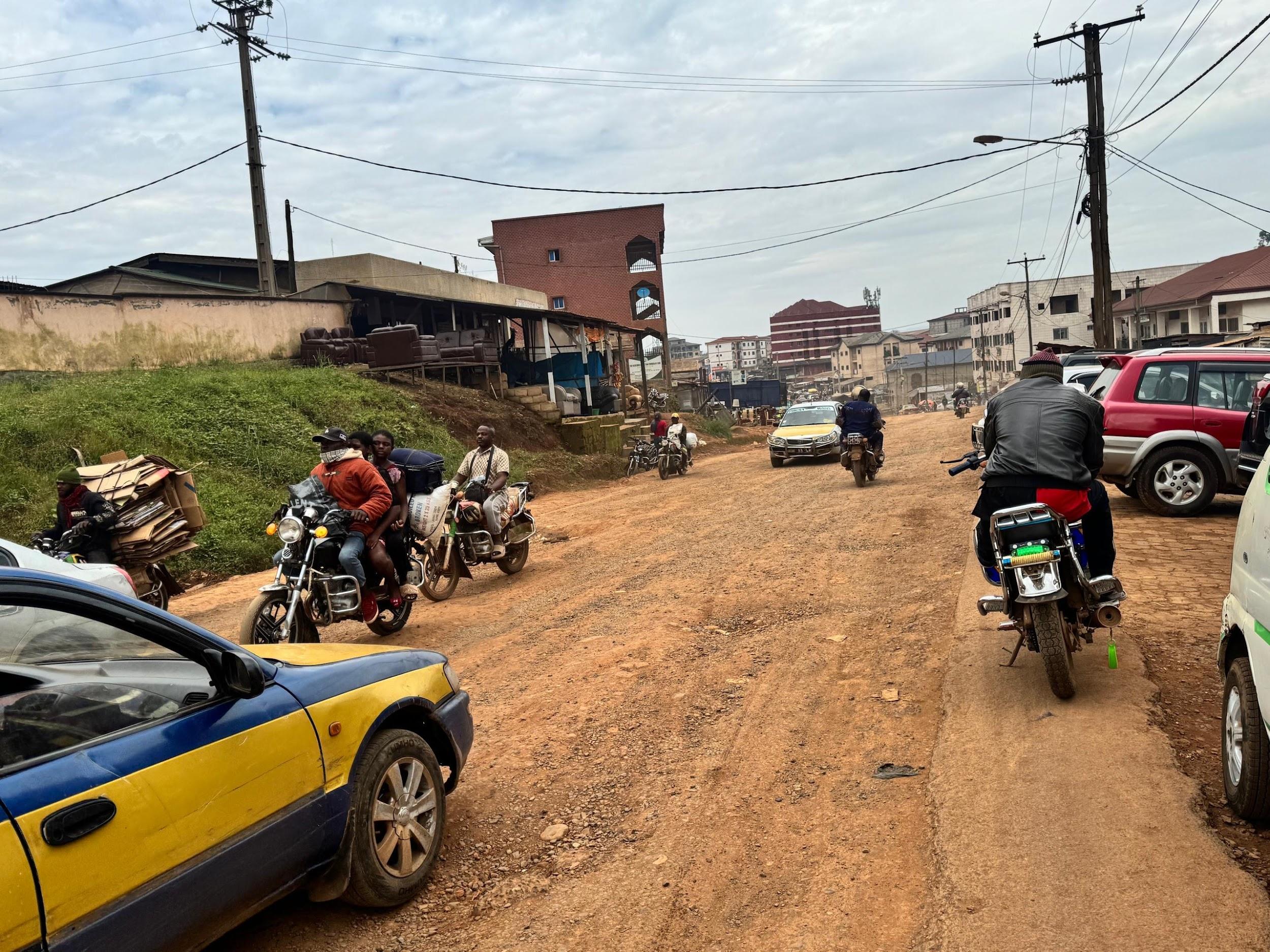
“Travelling to rural areas in Cameroon’s North West region continues to be dangerous and costly since the outbreak of the crisis in 2016, with fares rising from FCFA 2,500 (USD4.43) to FCFA 15,000 (USD26.58) per passenger. Drivers and passengers say insecurity, armed checkpoints and poor road conditions have turned routine travel into a daily risk.”
Written By Marie Leila BENYELLA
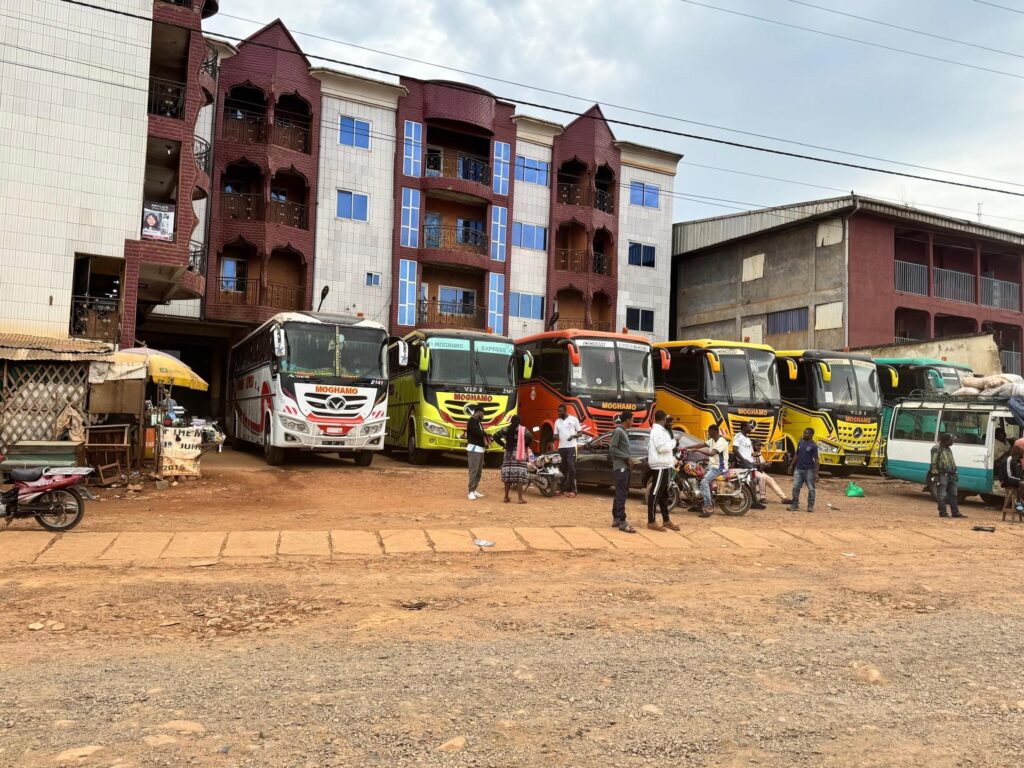
As early as 6:30 am at the City Chemist bus park in Bamenda, capital of the North West region of Cameroon, drivers and passengers assemble and start haggling over the high transport costs. What used to be a bus park has become increasingly full with motorbikes, as they are now the number one mode of transportation in this part of the country.
Patrick Tameh, a teacher who constantly uses the Bamenda-Bafmeng road axis recounts the dramatic increase in the transport cost. “In the years before the crisis erupted, a seat on the Bamenda – Bafmeng line cost FCFA 3,000 (USD 5.32). Today if we are lucky enough to find a driver willing to go down that route, we pay up to FCFA 25,000 (USD 44.30) going to 30,000 (USD 53.16) if you have luggage, and it is on a bike.” The hike in transport fare is not caused by increase in fuel prices as one may be tempted to think but rather, fear is. A bus driver, popularly known as Pa Tycoon, who makes trips from Bamenda to Kumbo in the Bui Division twice a week confirms the unusual increase in transport fare.“We charge danger money. I have a family to feed and my life to live,” Pa Tycoon says bluntly. “If I am risking my life to transport passengers, don’t I have the right to make some profit off of it?” Commercial motorbike riders commonly known as ‘Okada men’ have taken over many of the routes once served by buses. They claim their small machines can easily sprint off the road into the bush when danger is around the corner.
“A small trip that once cost FCFA 700 (USD1.24) is now FCFA 5000 (USD8.86). People insult us about this increase in transport, but we risk our lives every day,” a motorbike rider who plies the Bamenda-Menchum road, tells Atlantic Chronicles on condition of anonymity.
Meanwhile another commercial motorbike rider plying the same route, adds still on condition of anonymity: “We are more advantageous than bus drivers because we can easily evade these boys when we meet along the streets.”

Nine years into the armed conflict in the predominantly English-speaking North West and South West regions, transportation costs keep rising. Since the proclamation of results of the October 12 presidential election, separatist fighters have imposed road blockages on the borders of the North West region. This has made transportation into and within the region increasingly difficult, expensive and dangerous, amid the post-electoral protests and continued sociopolitical instability in the region.
A road network under siege
Since 2016, the forces of law and order have occupied several roads in Bamenda to fight the armed separatist groups. The roads that twist through Mezam, Ngoketunjia and Bui divisions have many checkpoints that shift unpredictably, with security forces and separatist fighters fighting for control. A transporter who requested anonymity to speak freely, said that both security forces and separatists extort money from civilians at these checkpoints.
“I ply the Bamenda – Ekok road and transport goods for people from Nigeria to Cameroon. We can go through more than 30 checkpoints on the road in a single journey and this is not even an exaggeration. We settle (bribe) both the military and the Amba Boys at these checkpoints so we usually have a lot of small bank notes with us. I just give FCFA 2,000 (USD3.54) whenever I’m pulled over and asked to support. Whether by the military or the Amba Boys,” he said.
Transport agency owners confirm that several buses have been burned along these routes in recent years. A local bus agency manager called Pa Dan recalled losing two vehicles in 2021.
“We stopped going to Belo and Ndu after my buses were attacked. Two of my drivers were asked to surrender their vehicles and they were killed in the process,” he said.
One of the few people who still dare to venture into these highways is Moki Mildred who frequents the Bamenda – Kumbo highway to oversee her family property. Moki is visually impaired and every trip in her case, is a leap of faith. “One day when I was on my way to Nso, the Amba Boys stopped my bus and they requested everybody to assist them in their struggle. I informed them that I’m blind and unemployed, and I only had enough money to take me to, and bring me back from the village. They were merciless to me and said that even the blind must help the revolution take place,” she narrated tearfully.
The hike in transportation prices in the North West region has led to an increase in market prices in Bamenda. The collapse of safe and accessible mobility has caused traders to increase their prices. Traders complain that the high cost of moving goods from the farms in the villages to town wipes out their profit. “A bag of beans that cost FCFA 3,000 (USD5.32) now sells at 6,000 (USD10.63) because transporters charge high,” Pauline Nahjela, a farmer from Bali Nyonga says. “Sometimes the crops rot before reaching the market, and this is always a great loss for me.”
Education and livelihood prohibited
Education is the institution that has suffered greatly under the weight of fear in the North West and South West region because of the crisis in Cameroon. Teachers assigned to remote schools often refuse deployment. Some like Mr Tameh who honour their duty, face kidnap from the separatist fighters on a daily basis. “I am a government secondary school teacher and this already puts a target behind my back because the separatists say I work with the government,” Tameh regretted. “When these separatists meet passengers on the way, they pick out the teachers from the group and carry them to their camps. While at the camps in the process of torturing you, they will ask you to multiply your salary by 12 months then by the number of years the crisis has been going on and give it to them,” he recounted.
A tactic of this nature, Tameh disclosed, would lead a lot of families with teachers and civil servants to bankruptcy. “The only reason I confidently travel those roads to school is because I have never been caught. I am lucky to have never been spotted as a teacher by one of those boys. But I fear what might happen if I am ever caught because my family would have to break several banks to meet the ransom demand,” he added with teary eyes.
The hike in transportation has affected the lives of many in the region, increasing poor standards of living. Mr Tameh Patrick explained that he spends close to FCFA 100,000 (USD177.20) monthly, only on transportation.
“Before the crisis, I used to stay in Bafmeng with my family. But due to the insecurity, we had to move out to safer communities in town. Now I have to be with them, while also being at my job. My family is still a young family and I’m the sole bread winner. I have to provide for my children, provide for my wife,” he said.
Tameh went on: “This causes me to be moving frequently on that road and sometimes in a month, I spend an extra FCFA 100,000 (USD177.20) which is money that I would have used to better the living conditions of my family rather than spending it on traveling.”
Albertine Nyamia, a court registry administrator at the Court of First Instance Wum and Menchum High Court, confirms the sorry state of affairs. “I can’t move to and from Bamenda as I want due to the high transportation cost, bad roads and the insecurity. I would have loved to be living in Bamenda and working in Wum. The idea of constantly traveling for long distances on a bike is also very risky for me,” Nyamia said.
The way forward
Officials at the Ministry of Trade who regulate the transportation tariffs in Cameroon, say they are aware of the transport situation in the area, while analysts and local community leaders agree that restoring confidence on the roads would require more than patrols. The armed conflict has led to loss of lives, property and sunken the economy of the region. The hike in transport costs is only one of the many adverse effects of this crisis on the North West region. If not addressed sooner, the story of hardships will continue to mar families who live in the area.
This article was produced as a result of a grant provided by the Cameroon Association of English-speaking Journalists (CAMASEJ) as part of a project funded by Open Society Foundations.