
By Sob Amyn FOUEJEU
Objective: To address the energy deficit in the division while stimulating agriculture, industry, and tourism through a participatory and sustainable model.
In the Menoua division [area: 1,380 km², Population (2001): 372,244. Density (2001): ~270 inhabitants/km², capital: Dschang], it is realistic to aim for a small hydroelectric power station of around 10 MW in “small hydro / run-of-river” mode, utilising a mountain watercourse, and to upgrade the Ntsinkop transformation substation. This would be achieved through a local participatory funding structure (tontines, cooperatives, development committees, diaspora, private investors).
- Menoua’s Energy Needs
Current Demand (2025)
· Total consumption: ~45 MW, comprising urban (households, industries, services) 35 MW and rural (20 villages) 10 MW.
· Deficit: 15–20 MW (reliance on diesel generators, rural electrification rate at 55%).
Project Objective
· Full coverage: 60 MW for 100% of urban households, 90% of villages, and support for emerging industrial zones.
- Capacities of the Nkam-Tsinkop Project
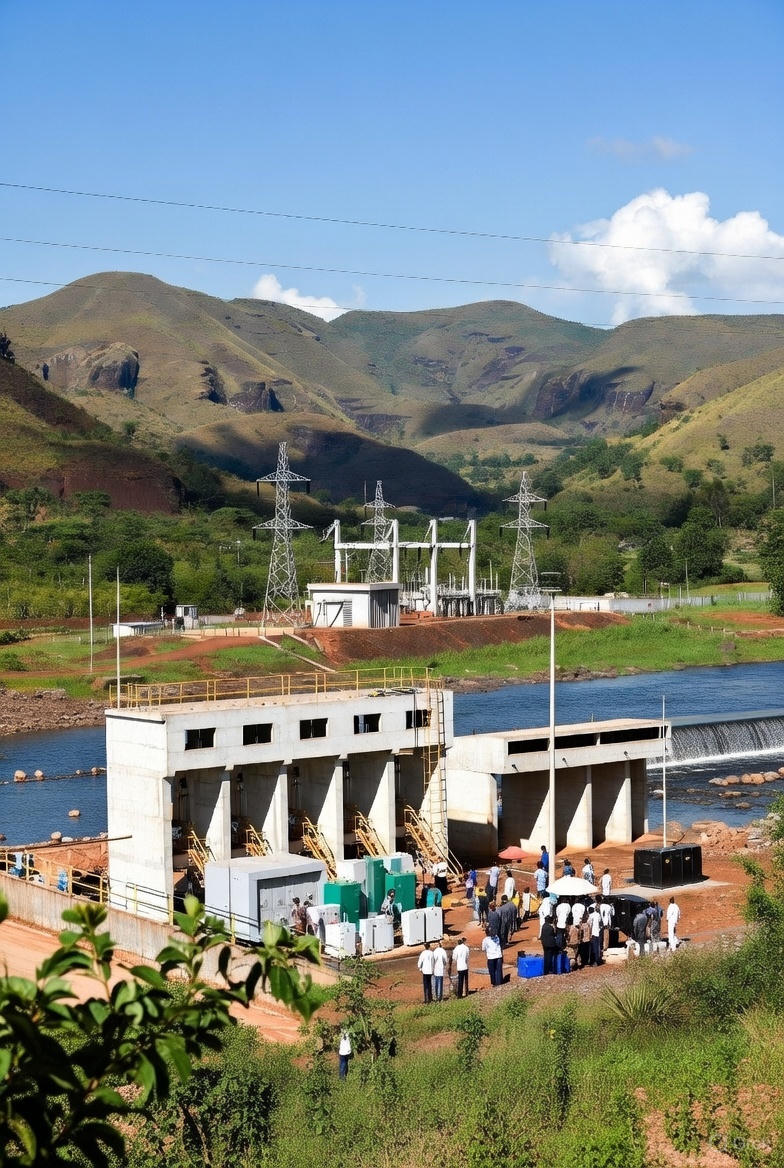
Nkam River Hydroelectric Power Station
· Installed capacity: 10 MW (base) + 3 MW solar (dry season supplement).
· Annual production: 65 GWh (hydro) + 12 GWh (solar) = 77 GWh/year.
· Equivalent to 60% of Menoua’s current needs.
Optimised Tsinkop Substation
· Distribution capacity: Increase from 15 MW to 25 MW thanks to a high-efficiency 33 kV transformer and a ring network reducing losses to 8%.
· Extended coverage: Power supply to 10 additional villages (30 villages total).
- Projected Revenue Over 25 Years
Key Assumptions
· Guaranteed tariff: 60 FCFA/kWh (power purchase agreement with ENEO/State).
· Demand growth: +3% annual (urbanisation, industrialisation).
· Operating costs: 25% of revenue (maintenance, salaries).
Financial Projections
Annual revenue(year 1): 77,000,000 kWh × 60 FCFA = 4.62 billion FCFA
Total revenue(25 years): ~178 billion FCFA
Net profit(25 years): ~134 billion FCFA
Return on investment:9–12 years (depending on community participation)
- Participatory Funding Model
Actors and Contributions:
· Local communities (30%): Participation via land contribution or local labour (valued as shares), with a minimum entry of 10,000 FCFA/share (capped at 5 shares/person).
· Menoua diaspora (40%): Online investment platform (crypto or transfers) with incentives such as 15% discount vouchers on family electricity bills.
· Private investors (30%): Local businesses (agro-industry) and international green funds. Minimum ticket: 5 million FCFA.
- Private Investor Remuneration Plan
Guaranteed rate of return: 7% annual for 9 – 12 years (indexed to electricity production).
Terms:
Communities:5% in cash + 3% as electricity credit and priority for project jobs.
Diaspora:7% in cash (international transfer) and partial tax exemption.
Private institutions:8% in cash + equity shares and access to local public procurement.
Reserve fund:10% of profits allocated to maintenance and extensions.
- Participatory Governance
· Establish a local steering committee: representatives from villages, councils, traditional authorities, cooperatives, and decentralised state services (MINEE, environment).
· Institute a community monitoring committee: oversight of local jobs, economic benefits (electrification of x villages or groups, connection of y households), and protection of watercourses.
· Implement a policy of social and productive tariffs, with incentive tariffs for artisans, SMEs, and agro-processing to maximise local economic impact.
- Multisectoral Economic Benefits
Agriculture
· Electrified irrigation for an additional 500 hectares of arable land (coffee, cocoa, vegetables).
· 40% reduction in post-harvest losses thanks to cold storage.
· Electric mills increasing productivity by 30%.
· Creation of 1,200 seasonal jobs.
Industry
· Industrial zones: 50% reduction in energy costs for 50 SMEs, attraction of 5–10 new processing units.
· Innovation: Electrified workshops for repairing agricultural equipment and local production of bio-fertiliser (energy for composting units).
Tourism
· Ecotourism: Development of the Nkam waterfalls (trails, eco-museum), creation of 20 rural lodges powered by green energy.
· Cultural tourism: Annual festivals (Bamiléké dance, crafts) boosted by reliable public lighting. 5,000 visitors/year expected (+2 billion FCFA in tourism revenue over 10 years).
- Role of Public Institutions
Rural Electrification Agency (AER)
· Grants: Covering 30% of rural connection costs.
· Training: Programmes for 200 local technicians (micro-grid management).
FEICOM (Special Council Support Fund for Mutual Assistance)
· Guarantee fund: Covering 50% of loans to agricultural cooperatives.
· Infrastructure: Funding for 10 km of roads to open up production areas and tourist sites.
Ministry of Energy
· Legal framework: Simplification of authorisation procedures (deadline reduced to 6 months).
· Guarantee a ceiling of 60 FCFA per kWh for a minimum of 12 years.
- Challenges and Mitigation
Climate variability: Water retention basin + hybrid solar panels.
Land conflicts:Mediation by traditional leaders + compensation in project shares.
Diaspora funding:Awareness campaign via social media and local associations.
Conclusion: This project, by combining energy autonomy and multisectoral development, positions Menoua as a model for a green economy in Central Africa. The stable revenue over 25 years and the cross-cutting benefits justify the participatory investment, subject to strong commitment from public authorities and communities.