
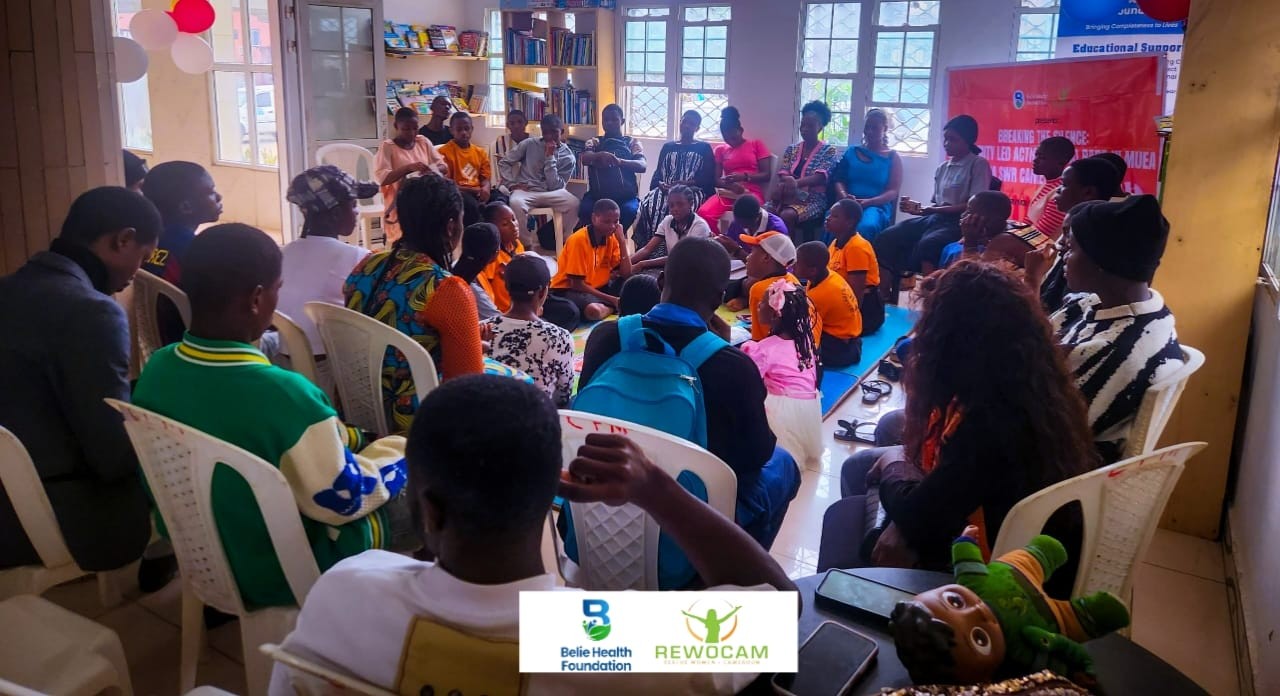
The Belie Health Foundation has carried out a project to educate children and adolescents on their sexual rights and how to report violations.
The awareness and sensitisation project, now in its second phase, began last December and has worked to help victims break their silence. This phase concluded on Saturday, January 31, in Muea, Buea.
According to the Belie Health Foundation, this phase reached five schools, 10 staff members, and over 700 children directly, and indirectly benefited more than 2,000 students and parents.
Abigail Abamukong, founder of the Belie Health Foundation, stated that rape and sexual violence are sensitive topics, and parents sometimes do not understand them or shy away from discussing them with their children.
She added that, in schools, many administrators and guidance counsellors needed support and training in handling sensitive disclosures, trauma response, and providing psychosocial support to students, especially survivors.
For this reason, the project worked to strengthen the capacity of school administrators and guidance counsellors and to engage directly with students.
However, this alone is not enough to curb the prevalence of rape and sexual violence in Muea. Therefore, the project concluded with a community dialogue that brought together local community advocates, students from participating schools, school staff, and parents. Over 50 participants attended the session.
“Discussions centred on the challenges adolescents face in speaking up and the difficulties parents face in discussing sex and sexuality with their children. The dialogue also addressed how parents, teachers, and community members can collaborate to prevent the rape of children,” said Abigail Abamukong.
“Guidance counsellors, teachers, and parents play a central role in the early detection, prevention, and reporting of rape cases,” the BHF founder added.
The objective of facilitating this intergenerational dialogue was to strengthen communication and community understanding of child and adolescent protection.
Following the various dialogue sessions in schools, some of the students openly shared their realities and concerns, highlighting: limited quality time with parents due to work, farming, or community meetings; breaches of confidentiality, leading to gossip and stigma; and absence of parental bonding, particularly with fathers, among others.
“My parents are so busy, they hardly even make time for us. Either work, come home late, farm, meetings…it’s always one thing or the other. So, I just keep to myself,” said Sally, a student from one of the schools.
For Nancy, another student, her parents use confidential information she tells them against her. “Sometimes, their friends even use it to gossip about me. I would like my parents not to judge me anymore but listen to me. I really want to have a bond with them so I can confide in them. I have a lot to say but no one to talk to,” Nancy added.
Meanwhile, for a parent like Mme Lydia, she has always tried to have intimate discussions with her daughter, but her daughter does not trust her. “She rather talks to neighbours who end up telling me. Sometimes, I try to bond with her by watching a film, cooking together or just taking a stroll and discussing, but she doesn’t talk. Her father doesn’t talk much; however, I asked him to have a conversation with her which he said he did, but never told me what was said. She hasn’t changed and it’s challenging for me. I don’t know what to do,” said Mme Lydia.
But for Mme Juliet, who is a teenage mother, she has normalised discussions around sexuality while her children are still very young. “I don’t see any reason why my daughter should know about menstruation only the day it starts. Sometimes, I bathe with them just to make them feel comfortable and transparent with me. I have noticed many children shy away from their parents because their parents hide things that are not to be hidden from them,” she added.
Abamukong explained that Muea was chosen because the locality continues to experience incidents of rape and sexual assault among children and adolescents due to: limited awareness of rights, consent, and reporting; inadequate communication between parents and children; poor understanding among teachers of modern sexual violence challenges; stigma surrounding rape disclosure; and weak school-based prevention programmes.
Through the project, BHF aims to address these gaps by equipping school counsellors, increasing rape awareness through school campaigns, and strengthening community–school dialogue.
Though implemented by the BHF team, the SUVAR project was funded by Rescue Women Cameroon.