
By Wifah J. Nde
In early April 2026, young girls – some visibly Muslim, others from different faith backgrounds marched through the streets of Bamenda, raising their voices against growing sexual violence against minors. “Even in our veil, we still get raped,” Salamatou Awal from the Muslim Community in Old Town – Bamenda declared.
Her words struck the spine of anyone who cares to listen, exposing a painful truth often left unspoken—no space, not even those considered sacred, is immune to abuse.
A Crisis in Plain Sight
The protest in Bamenda zooms in on growing injustices against women and other minority groups, affecting girls and women across communities, including within religious institutions. For many survivors, the silence surrounding abuse is reinforced by fear, stigma, and deeply rooted power structures.
Community leaders who joined the march acknowledged that violations often occur not at the hands of strangers, but within trusted circles.
“Many of these girls have been violated by people they know and trust,” Mirabelle, a local leader, said, calling attention to the vulnerability of minors within both public and private spaces, including places of worship.
Illuminating the Dark Veil over Faith Communities
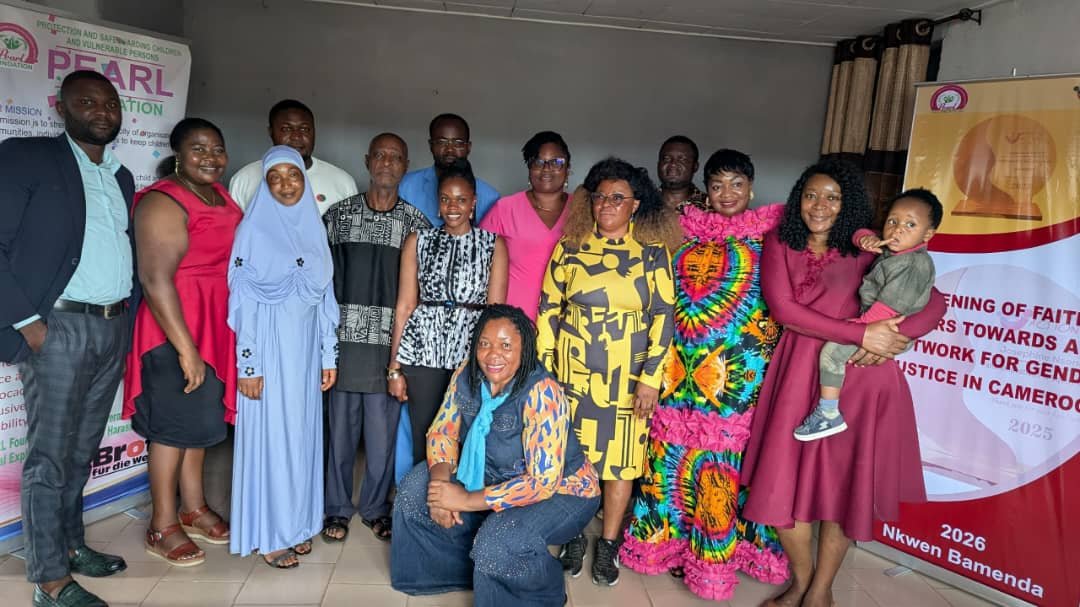
Disturbed by this growing phenomenon, Pearl Foundation convened a diverse group of faith-based leaders, legal experts, and civil society actors to confront the issue head-on. They sought to examine how religious environments, often seen as moral sanctuaries, can also become spaces where gender injustice is concealed and perpetuated. The reflections, Josephine revealed, will inform consultative actions for a Faith-Based Network against Gender Injustice in Cameroon
Nsono Josephine, Founding Coordinator of the Pearl Foundation, challenged participants to rethink long-standing narratives. Drawing from the biblical story of Amnon and Tamar, she highlighted how patterns of abuse, silence, and protection of perpetrators are not new but have been normalised over time.
Power imbalance, patriarchal structures and sexual violence are the three major drivers of gender injustice within faith settings, she argued. “These factors continue to create conditions where abuse thrives,” she explained. “And too often, religion is used as a shield to avoid confronting these realities.”
“Abuse often happens from within, not from strangers,” she said. “We must name sexual violence in faith communities for what it is, challenge harmful structures, and ensure that human rights are not violated in the name of belief.”
Gaps in Protection and Awareness
As discussions deepened, participants began reflecting on their own institutions. Many acknowledged a lack of clear policies to address gender-based violence, limited awareness among followers and leaders and weak or non-existent reporting mechanisms. In some cases, existing instruments were described as vague or rarely enforced.
These gaps, participants agreed, are precisely what allow abuse to persist, often unchecked and unreported.
Building a Network for Change
Out of these reflections emerged a shared commitment; the creation of a faith-based network to confront gender injustice.
The proposed network aims to raise awareness within religious communities, equip leaders with tools to prevent and respond to abuse, promote accountability and survivor-centred approaches and encourage open dialogue on issues often considered taboo
A steering committee to begin the formalisation process for the network was immediately created and tasked with laying the foundation for action.
A Call That Cannot Be Ignored
Back in Bamenda, the voices of the young girls continue to echo beyond protests. As faith leaders begin to organise and confront uncomfortable truths within their own spaces, they pledge that collective efforts will lead to lasting change, so that places of worship go beyond symbols of moral guidance to become genuine sanctuaries of safety and justice.