
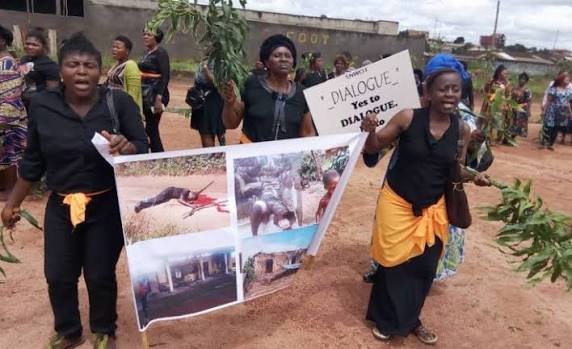
A partial casualty list documenting 4,037 deaths linked to Cameroon’s decade-long Anglophone conflict has been released, with rights campaigners warning that the figure represents only a part of the lives lost since the crisis began in 2016.
The list was presented in Buea on Tuesday, October 6, 2026 by Barrister Felix Agbor, popularly known as Agbor Balla, during a media conference to mark 10 years since the outbreak of the crisis.
Compiled by volunteers working with the Global Campaign for Peace & Justice in Cameroon and the Centre for Human Rights and Democracy in Africa (CHRDA), the document contains the names of 1,548 victims, while 2,489 remain unidentified. It covers civilians, separatist fighters and defence and security personnel.
Civilians make up the largest category, with 2,844 reported deaths, followed by 689 armed separatists and 504 defence and security personnel.
The figures show a sharp escalation in violence after the crisis erupted. The list records 12 deaths in 2016 and 80 in 2017 before the annual toll surged to 1,029 in 2018, the highest figure recorded in the dataset.
There were 569 deaths in 2019, 730 in 2020 and 702 in 2021. The number then fell to 298 in 2022, 208 in 2023, 105 in 2024 and 109 in 2025.
For 2026, the list records 195 deaths up to October 3, indicating that lethal violence remains a significant feature of the conflict a decade after it began.
Human rights lawyer Agbor Balla, said the initiative was designed to ensure that victims are remembered as individuals rather than reduced to statistics.
“We felt that it was necessary to immortalise the names of those who have died,” he said, stressing that the documentation would help ensure that the victims remain part of the historical record.
Nkongho acknowledged that the list was incomplete, describing it as a starting point rather than a definitive casualty register.
“We know that it is not a complete list, but it is a list that can be used for reference purposes,” he said, inviting families and members of the public to submit additional information to help expand and verify the records.
The organisers are seeking the names of people who died as a result of the crisis, together with the date and location of death and whether the victim was a civilian or combatant. Other supporting information is also welcome.
Nkongho said the documentation could eventually support truth and reconciliation initiatives, reparations, memorialisation and the pursuit of justice.
“If someday we have a Truth and Reconciliation Commission, these are things that could be used,” he said, adding that the victims could also be remembered through a museum, memorial or public space bearing their names or photographs.
He stressed that the exercise was not intended to apportion blame or justify the killing of any category of victim.
“We are not apportioning blame. We are simply saying that these were people who died as a result of a conflict,” he said.
The list was compiled using automated searches, including artificial intelligence tools, alongside manual verification of reports from trusted news organisations and selected social media sources. Duplicate entries were removed and information standardised.
However, the campaign cautions that the 4,037 deaths should not be regarded as the overall death toll of the conflict.
The organisers cite an International Crisis Group estimate of 6,000 deaths by May 2021 and figures attributed to the Armed Conflict Location & Event Data project (ACLED), which indicate more than 5,000 additional deaths between mid-2021 and the end of 2025.
Based on these figures, the organisers estimate that the conflict may have claimed at least 11,000 lives between 2016 and 2026, although the exact toll remains difficult to establish.
For Nkongho, the fluctuations in recorded deaths are a reminder that the conflict cannot simply be viewed as gradually disappearing.
“What it says is that we are toying a lot with human life, and that’s something that we should not do,” he said.
He called on the government, community leaders, journalists, civil society organisations and ordinary Cameroonians to make peace a priority.
“Peace should be our main focus. It should be a 24/7 agenda,” he said.
The Global Campaign for Peace & Justice in Cameroon says the partial list has three main objectives: acknowledging victims and the suffering of their families, documenting deaths for accountability, and contributing to a national conversation on wrongdoing, apology and healing.
The campaign is also advocating an inclusive dialogue process capable of producing a political roadmap for resolving the conflict, which began with protests in Cameroon’s English-speaking regions in 2016 before escalating into an armed separatist conflict.
After a decade of violence, the organisers say, documenting the dead is also a reminder of the enormous human cost of a crisis that continues to displace communities and disrupt lives across the Northwest and Southwest Regions.