
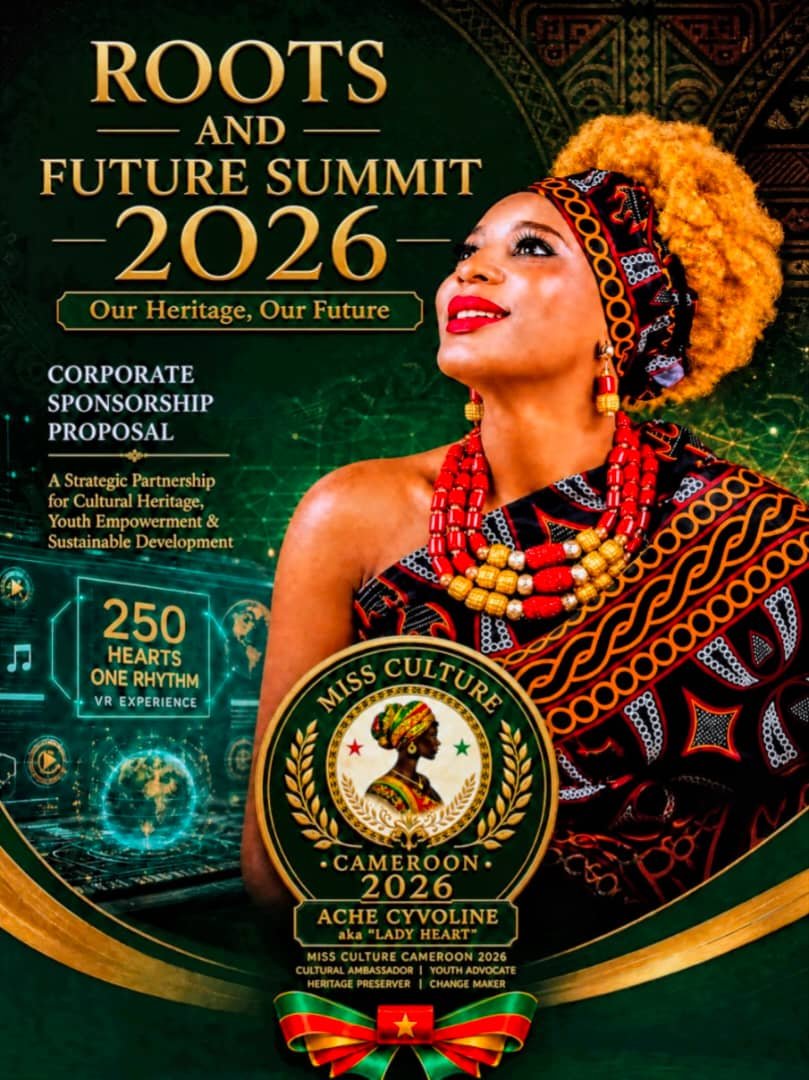
Miss Culture Cameroon 2026, Ache Cyvoline, has warned that Cameroon risks losing an important part of its cultural identity if urgent steps are not taken to reconnect young people with the country’s traditions, languages and indigenous knowledge.
Cyvoline, popularly known as “Lady Heart”, was speaking ahead of the Roots and Future Summit 2026, a national initiative designed to bring traditional rulers and young people together to discuss the preservation and future of Cameroon’s cultural heritage.
Describing the summit as a “rescue mission” rather than a festival, she said the initiative seeks to place Cameroon’s traditional institutions including its Fons, languages and customs alongside the country’s youth, technology and digital future.
“How do we remain Cameroonian in a world that wants us to forget who we are?” she asked.
The summit’s concept note describes the Roots and Future Summit as a two-day national gathering bringing together traditional rulers, cultural custodians, youth leaders and cultural institutions to address what organisers consider the growing erosion of Cameroon’s heritage.
More than 50 traditional rulers from Cameroon’s 10 regions are expected to participate. Organisers want the gathering to provide a platform for Anglophone and Francophone traditional institutions to work together and sign a Chiefs’ Accord committing them to practical cultural preservation measures.
For Cyvoline, the need for such a platform stems from what she sees as a widening generational gap.
“I was tired of seeing my generation ashamed of their culture,” she said.
“I realised youth have the energy but no knowledge, and Fons have the knowledge but no youth. If we don’t connect them now, in 10 years the bridge will be broken forever.”
The summit concept note identifies rapid urbanisation, language loss, youth disengagement and weak institutional coordination among the factors contributing to the erosion of Cameroon’s cultural heritage. It argues that traditional rulers possess significant moral and institutional authority within their communities and can play a central role in reversing the trend.
Languages, traditional knowledge under threat
Cyvoline identified the decline of indigenous languages, the loss of traditional healing knowledge and the weakening of cultural values as some of the most worrying signs of heritage erosion.
She said many young people are becoming increasingly disconnected from their mother tongues and traditional practices, while elderly custodians of indigenous knowledge are dying without passing that knowledge to younger generations.
“The respect for the Palace, the rites of passage, the sense of community — our young people now think culture is something backward, for the village,” she said.
The summit intends to move beyond discussions by seeking concrete commitments from participating kingdoms. According to the organisers, each participating Fondom will be encouraged to document at least one endangered tradition and train young people to help preserve it.
The concept note lists more than 50 kingdom-specific commitments, alongside the Chiefs’ Accord and the creation of a post-summit Council of Fons, among the initiative’s key deliverables.
Using technology to revive culture
A major feature of the initiative is the proposed 250 Hearts One Rhythm digital platform, which is intended to bring Cameroon’s cultural diversity into the digital space.
Cyvoline said the platform will allow young people to learn words and proverbs from Cameroon’s languages, watch short videos of traditional dances, rites and festivals, and access information about the traditional uses of medicinal plants.
The summit concept note says the application is intended to digitally archive Cameroon’s cultures, languages, rituals and traditions and make them accessible to schools and diaspora communities.
Cyvoline believes young people are more likely to embrace their heritage when it is presented in ways that connect with their everyday digital lives.
“I will not convince them with lectures. I will convince them with pride and profit,” she said.
“When a young person sees his language on an app, his dance on TikTok with one million views, his grandmother’s herbal remedy being sold internationally — he will be proud.”
Her message is that culture should no longer be presented simply as something inherited from the past, but as a potential source of creativity, identity and economic opportunity.
“Culture is the new entrepreneurship,” she said.
The organisers insist that the summit is intended to produce measurable outcomes rather than end with ceremonial declarations.
A monitoring mechanism involving the Ministry of Arts and Culture, the Council of Traditional Rulers and the Miss Culture Cameroon Foundation is planned to track implementation of commitments.
The concept note also proposes quarterly meetings of a Council of Fons to monitor progress, address challenges and share best practices.
The summit is expected to bring together approximately 500 participants, including traditional rulers, cultural custodians, young people and students, media representatives and institutional partners.
Discussions will focus on areas including language, rituals, crafts, arts and digital preservation, while workshops will examine documentation, the integration of culture into schools, diaspora engagement and cultural tourism. The programme will culminate in the drafting and signing of the Chiefs’ Accord.
For Cyvoline, the ultimate objective is to ensure that Cameroon can embrace the future without losing the cultural identity that defines its people.