
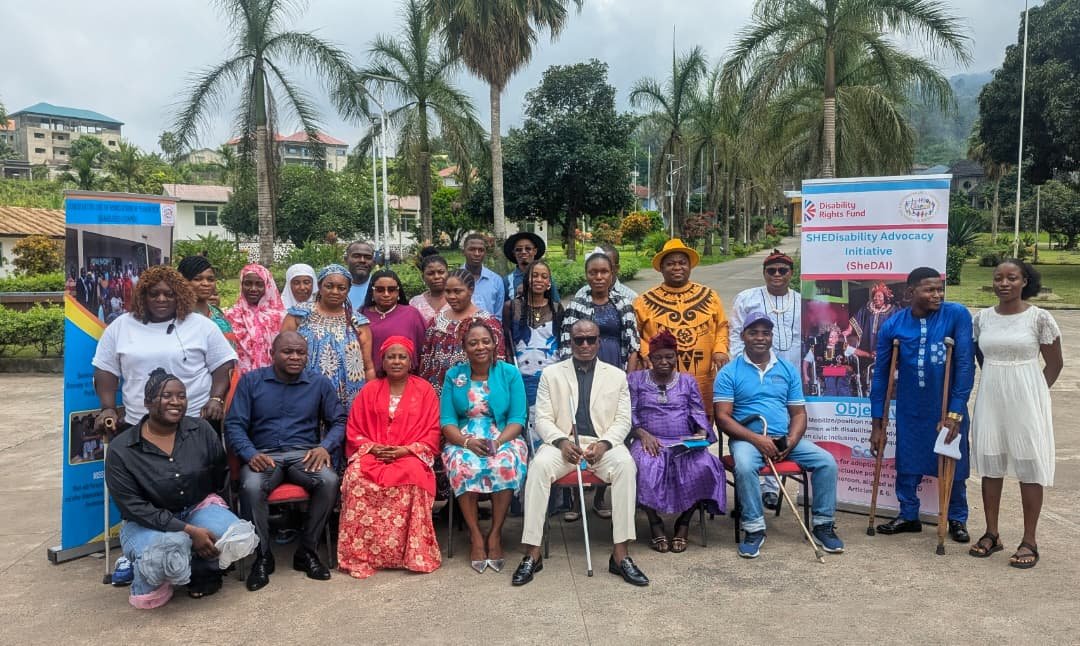
Women and girls with disabilities in Cameroon’s Northwest and Southwest regions are set to benefit from a new advocacy and empowerment initiative aimed at tackling discrimination, promoting inclusion and amplifying their voices in decision-making processes.
The She Disability Advocacy Initiative (SHEDAI) project was officially launched by the Coordinating Unit of Associations of Persons with Disabilities (CUAPWD) during a two-day capacity-building workshop bringing together leaders of Organisations of Persons with Disabilities (OPDs), community stakeholders and government representatives.
Funded by the Disability Rights Fund, the project is being piloted in the Northwest and Southwest regions. Organisers say it could be expanded to five additional regions of Cameroon if the pilot phase proves successful.
Speaking at the launch, CUAPWD General Coordinator, Chick Sama, said the initiative emerged from a thorough assessment of the challenges faced by women and girls with disabilities.
“Our guiding principle is ‘Nothing About Us Without Us,’ which means that persons with disabilities must be involved in every decision, action, implementation process and advocacy effort that concerns their rights and well-being,” he said.
According to Sama, the project is built around three pillars: strengthening the capacities of disability organisations and their staff, building a strong and independent voice for women with disabilities, and bringing stakeholders together to address challenges affecting women and girls with disabilities.
“The second pillar is centred on building a strong and independent voice for women with disabilities. This will be achieved through the creation of a network led by women with disabilities themselves,” he explained.
He said the project aims to transform societal attitudes and create a united network of women with disabilities capable of advocating for their rights and reporting violations.
Representing the Ministry of Social Affairs, Madam Efange Placit, Chief of the Control Brigade of Social Action for the Southwest Region, and representative of the Southwest Delegate for Social Affairs described the initiative as a welcome step towards greater inclusion.
“It is inspiring to see persons with disabilities, with the support of their partners, taking the lead in implementing a project of this nature themselves,” she said.
Placit noted that the project’s objectives align with the Ministry’s mandate of promoting social inclusion and protecting vulnerable groups.
“We want to see women with disabilities taking their rightful place in society, particularly in decision-making processes and in socio-economic development. This initiative has the potential to advance their autonomy, improve their quality of life and promote the dignity that every person deserves,” she added.
For Abigail Ngwe, Women Project Officer at CUAPWD, SHEDAI is about both empowerment and changing perceptions.
“This project is not only about empowering women with disabilities; it is also about transforming the way communities perceive and treat them,” she said.
Ngwe explained that participants will be trained on national and international legal instruments protecting the rights of persons with disabilities and equipped with advocacy skills to drive change in their communities.
Dr Charly Nyugap, Interim Chairman of CUAPWD Southwest, said implementation would begin with training sessions for CUAPWD staff and OPD leaders from Fako and Meme divisions, who will in turn train others at the grassroots level.
“These participants will take the knowledge and information acquired here back to their respective communities, where women and girls with disabilities live and work,” he said.
The project will also engage community leaders, religious leaders, traditional authorities, civil society organisations and government officials. It will culminate in a policy dialogue aimed at developing recommendations to improve the inclusion and protection of women and girls with disabilities.
Organisers hope the initiative will lay the foundation for broader policy reforms and contribute to a society where women with disabilities can live with dignity, participate fully and enjoy equal opportunities.