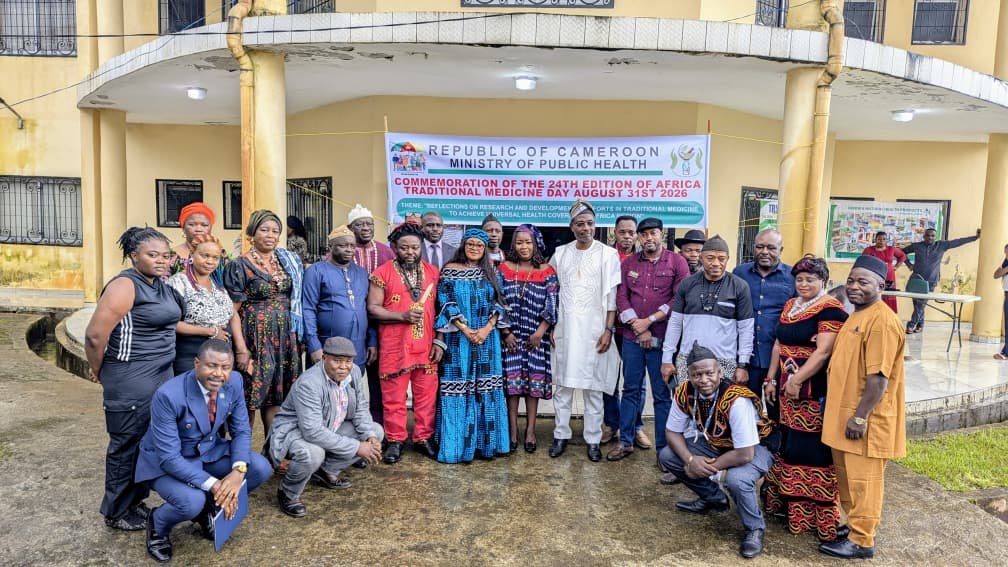
Traditional medicine took centre stage in Buea on 29 August as practitioners, government officials and cultural stakeholders from the Southwest region gathered to mark the 24th edition of African Traditional Medicine Day.
The commemoration, hosted at the Regional Delegation of Arts and Culture, was held ahead of the official 31 August date under the theme, “Reflection on Research and Development Efforts in Traditional Medicine to Achieve Universal Health Coverage in Africa Region.”
Among the prominent voices at the event was naturopath Dr Fru Richard, who described African traditional medicine as the foundation upon which other forms of medicine have developed.
“African traditional medicine is the bedrock of all medicine,” Dr Fru said, arguing that its long history and connection to African communities give it a natural and enduring place in healthcare.
He stressed that traditional medicine should not be treated simply as an alternative to modern medicine, insisting that it remains an important part of Africa’s cultural heritage, identity and way of life.
According to Dr Fru, more than 80 per cent of Africans rely on traditional medicine for their healthcare needs, making greater recognition and awareness of the sector essential.
He also called for closer collaboration between traditional and modern medicine as a pathway towards Universal Health Coverage.
“African traditional medicine and modern medicine must work together,” he said, explaining that the two approaches may differ in philosophy and treatment methods but can complement each other in promoting holistic health.
Dr Fru, who has been involved in discussions on the regulation of traditional medicine since 2017 as one of the representatives working on the proposed legislation, also identified regulation as one of the sector’s major challenges.
He said the proposed law is expected to address several issues, including the problem of quacks, but noted that practitioners were awaiting its promulgation before commenting further on its implementation.
For Dr Ibrahim Mohamed, Regional Coordinator of one of the associations in the Southwest Region, better organisation of practitioners is key to improving standards. He called for practitioners to form associations through which genuine practitioners could be identified and charlatans exposed.
He also proposed the creation of an Institute of Herbal Medicine where practitioners could receive appropriate training and professional development.
The Southwest Regional Delegate of Arts and Culture welcomed the decentralisation of the commemoration, noting that it brought government activities closer to the grassroots. She stressed the importance of preserving traditional medicine as part of Cameroon’s cultural heritage while urging practitioners to take their responsibilities seriously because they deal directly with human lives.
Southwest Regional Delegate of Public Health, Dr Eko Eko Filbert, said traditional medicine has an important role to play in achieving Universal Health Coverage, noting that it would be difficult to meet the goal using modern medicine alone.
He emphasised the importance of scientific research in making traditional medicine more widely accepted and strengthening the sector.
The commemoration ended with renewed calls for research, proper training, regulation and stronger collaboration between traditional medicine practitioners and conventional healthcare professionals.
By Akuro Nancy Bright Acha & Ajang Blessing (UB Jourtnalism Students on Internship)